

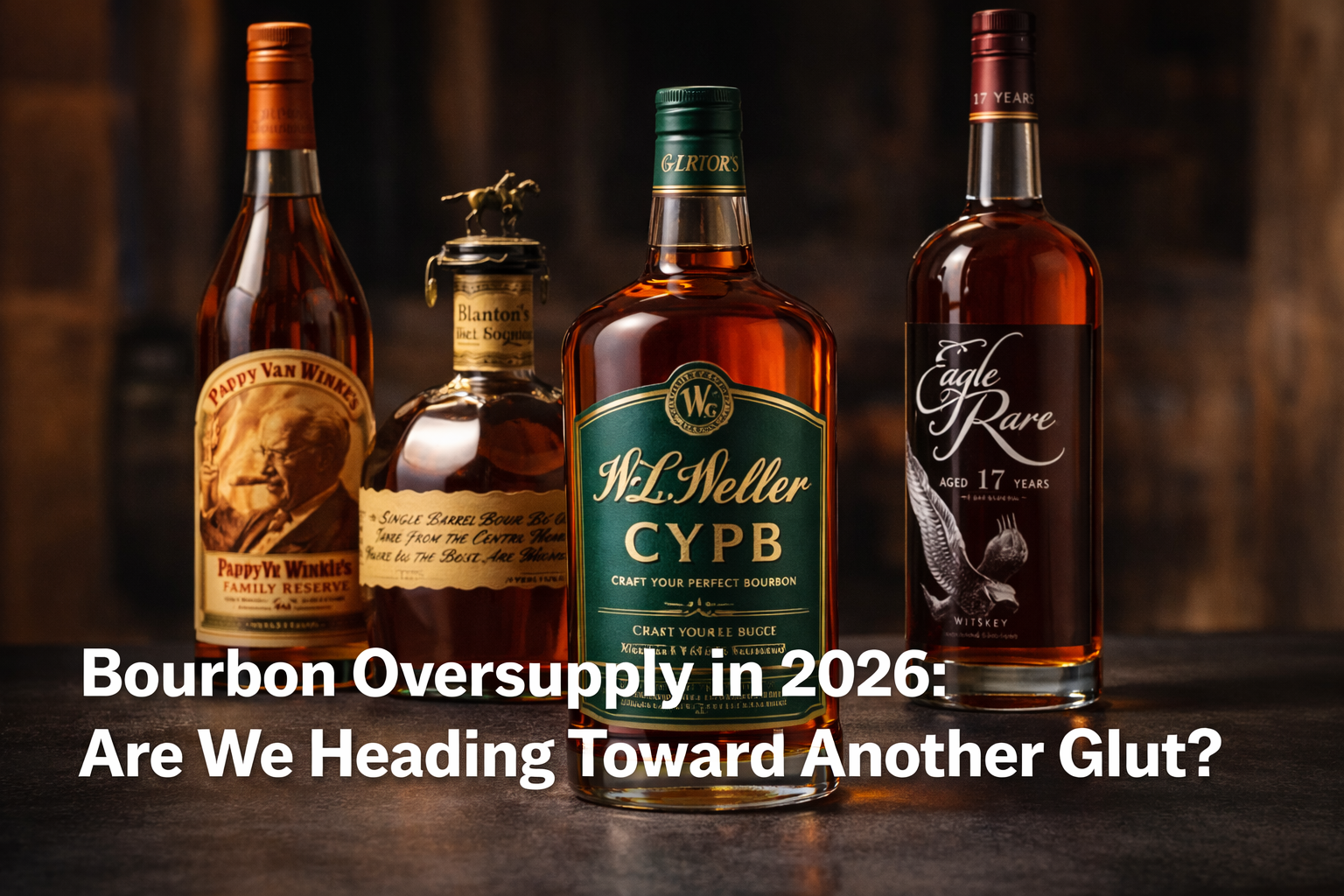
For over a decade, bourbon seemed unstoppable.
Distilleries ramped up. New labels appeared constantly. Scarce bottles vanished immediately. Individual barrels sold out. Investors moved in. Tours boomed.
Yet bourbon faces one inherent hurdle: it requires several years to mature.
And when production decisions made 4–8 years ago meet slower demand today, the economics can quickly change.
In 2026, bourbon barrel inventories are high, premium demand growth has moderated, and more producers are competing for the same retail shelf space.
This brings up a valid question:
Are we heading toward another bourbon glut?
Bourbon oversupply in 2026 is becoming a growing concern as barrel inventories reach record levels while premium whiskey demand slows. Distilleries expanded aggressively during the bourbon boom between 2018 and 2022, and those barrels are now entering the market. While the industry is not facing a collapse, supply pressure could lead to pricing adjustments and increased competition among bourbon brands.
To understand the situation, it helps to look back.
The 1970s Bourbon Glut: What Actually Happened?
During the 1950s and 1960s, American whiskey dominated the domestic spirits market. Demand was steady, and producers expanded output to meet expected long-term growth.
Then consumer preferences shifted.
Vodka's popularity soared. Lighter spirits became fashionable. Younger drinkers felt less connection to established bourbon brands. Health trends worked against darker liquors.
However, production had already increased years earlier.
By the mid-1970s, the industry had more aging bourbon than it could sell.
Warehouses filled up. Prices softened. Distilleries consolidated or shut down.
Iconic producers like Stitzel-Weller eventually ceased operations. Survivors such as Heaven Hill and Jim Beam weathered years of contraction before the category stabilized.
The irony?
Some of the most sought-after ultra-aged bourbons today were originally distilled during that period of oversupply — barrels that simply aged because there was no demand at the time.
The key lesson was simple:
When you produce too much of a product that requires years of aging, corrections take years — not months.
The Bourbon Boom (2010–2022)
The modern bourbon resurgence looked different but followed similar behavior.
Demand surged due to:
- Premiumization and higher price points
- Growth in international exports
- Expansion of craft distilleries
- Private barrel programs
- Allocation culture and limited releases
- Increased tourism and brand storytelling
Major producers like Buffalo Trace Distillery, Brown-Forman, and Beam Suntory invested heavily in expanding capacity.
New rickhouses were built quickly. Smaller producers entered the market. Contract distillation increased.
The assumption was that demand growth would continue at a similar pace.
But whiskey production decisions made between 2018 and 2022 are now meeting a very different consumer environment.
Why Bourbon Production Is Outpacing Sales Today
Several factors are converging in 2026.
1. Slowing Premium Spirits Growth
Post-pandemic normalization has cooled the surge in high-end spirits. Consumers are becoming more selective with premium purchases.
2. Distributor Inventory Build
Distributors placed larger orders during peak demand. Retail sell-through hasn't always matched shipments.
3. Consumer Budget Pressure
Higher interest rates and economic uncertainty have impacted discretionary spending — particularly for bottles priced between $70 and $150.
4. Brand Proliferation
The number of bourbon brands competing for shelf space has increased dramatically. Shelf space itself has not.
5. Record Bourbon Barrel Inventories
Kentucky distilleries currently store millions of aging barrels, reflecting years of aggressive production expansion.
When production exceeds consumption, pricing power gradually weakens. Not overnight — but slowly over time.
Is This Another 1970s-Style Collapse?
Probably not in the exact same form.
Today's bourbon market differs in several key ways:
- Broader global demand
- A more diverse consumer base
- More advanced brand marketing
- Established premium and ultra-premium tiers
However, cyclical corrections are normal in capital-intensive industries.
Early signs of softening include:
- Increased retail discounting
- Previously allocated bottles staying on shelves longer
- More availability of private barrel selections
- Quiet consolidation activity
- Financial pressure on smaller producers
This is not necessarily a crash scenario.
Instead, it represents market normalization.
But normalization in a system with excess production capacity can take time.
What a Bourbon Oversupply Could Mean
If oversupply continues, the industry could see:
- Ongoing pricing pressure in mid-tier bourbon segments
- Increased promotional activity
- Greater selectivity from distributors
- Brand consolidation
- Reduced production runs in the future
The greatest risk falls on producers who expanded aggressively without building strong long-term brand demand.
Legacy producers with strong balance sheets tend to weather industry cycles more effectively
The Key Question for 2026 and Beyond
The bourbon industry has experienced oversupply before.
The difference between a mild correction and a prolonged glut often comes down to production discipline.
Will producers reduce new barrel fills quickly enough?
Or will they continue assuming demand will rebound faster than it actually does?
Because once barrels are filled, they cannot be unfilled.
And storing aging inventory carries real financial costs.
Final Perspective
The bourbon category is not disappearing. Demand remains strong compared to historical averages.
However, the explosive growth phase of the 2010s bourbon boom has clearly slowed.
Barrel inventories remain high. Competition is intense. Consumers are becoming more selective.
History does not repeat perfectly — but it often rhymes.
The lesson from the 1970s bourbon glut is not that bourbon disappears.
It is that overconfidence in endless growth can become expensive in an industry where production decisions echo for years.
At MidwestWhiskeyBuyer.com, we continue tracking supply trends, inventory signals, and real-world retail activity across the Midwest.
Because in bourbon, timing and discipline matter just as much as aging.
As the bourbon market evolves, collectors and private bottle owners may also wonder where to sell my whiskey or how to sell my bourbon safely in a changing market. If you’re considering selling rare bottles, understanding current demand trends can help you decide the right time to list or work with a professional buyer.
Read more: how-much-is-my-old-bourbon-worth


