

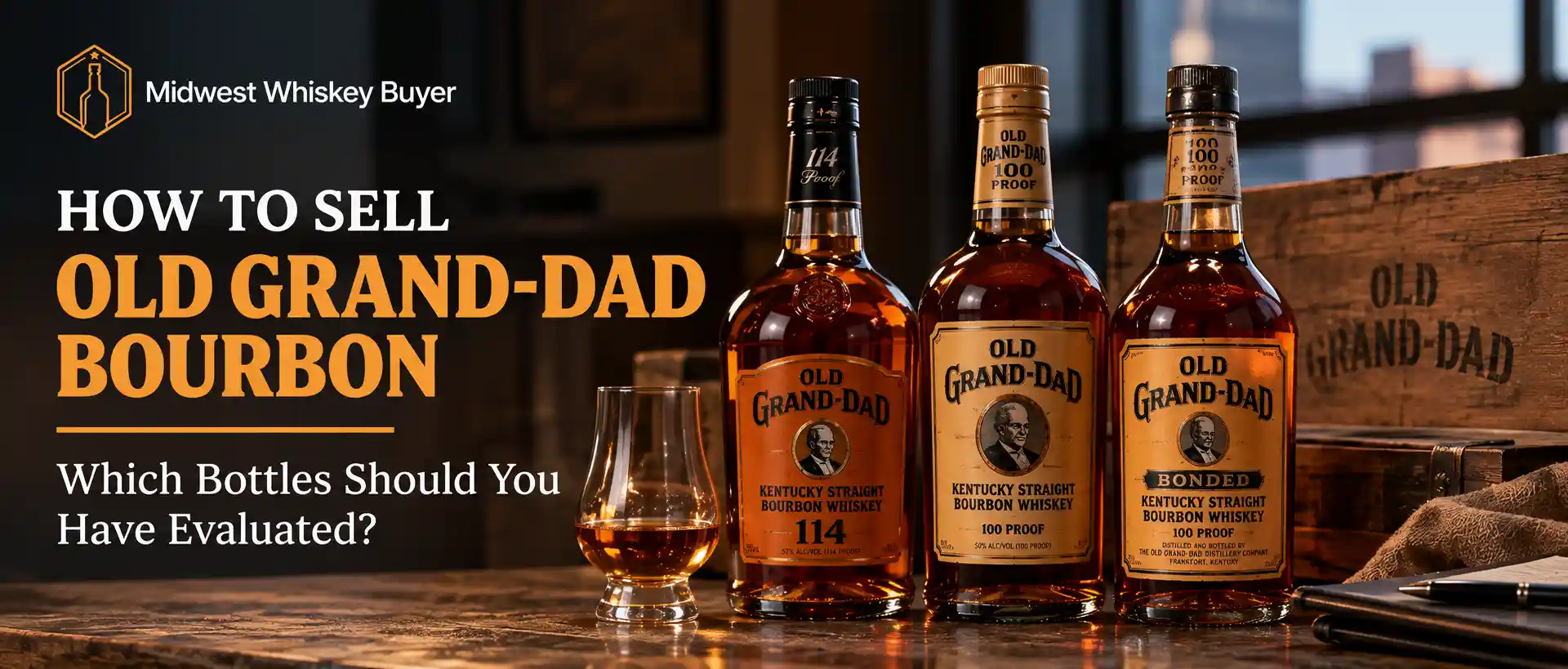
Old Grand-Dad is the kind of bourbon that can be easy to overlook until you put the right bottle on the table. The brand has been bottled since 1882, but today's lineup also includes high-proof, bonded, single-barrel, and limited expressions. For someone who owns an Old Grand-Dad bottle, that creates an important question: what exactly do you have?
That question matters when you are considering a sale. A standard modern bottle, a vintage Old Grand-Dad, an older bonded label, an OGD 114, and a limited release should not automatically be treated as the same bottle. At Midwest Whiskey Buyer, the evaluation starts with the individual bottle and the details that identify it.
If you found an Old Grand-Dad in an inherited collection, pulled one from a basement or cabinet, or have been holding onto a bottle for years, this guide gives you a practical starting point before you contact a buyer.
The Old Grand-Dad Name Covers More Than One Kind of Bottle
The current Old Grand-Dad portfolio includes Classic 80 Proof, Bottled-in-Bond, 114, 7 Year Bottled-in-Bond, 114 Single Barrel 7 Year, and the limited 16 Year 100 Proof release. That range is important for sellers because the exact expression is one of the first things a buyer needs to establish.
It also means that an older bottle should not be identified simply by comparing it with today's shelf bottle. Label design, proof, age statement, bottle format, closure, and other physical details can point to a different production era or expression.
Which Old Grand-Dad Bottles Should You Have Evaluated?
Vintage Old Grand-Dad
This is where the brand becomes especially interesting for collectors. Older Old Grand-Dad bottles can look very different from current releases, and the bottle itself often carries the clues needed to understand what you have.
If your bottle has an older label, paper tax strip, unusual bottle shape, older proof statement, or discontinued presentation, photograph those details rather than trying to identify the bottle from the front label alone.
Midwest Whiskey Buyer specifically includes Old Grand-Dad among the older American whiskeys it evaluates. Our broader guide to old bourbon bottles explains why production era, condition, fill level, and identifying details matter when an older bottle is reviewed.
Old Grand-Dad Bottled-in-Bond
Old Grand-Dad Bottled-in-Bond is a 100-proof expression with a long-running place in the brand's lineup. The current official description identifies it as a straight bourbon aged at least four years and bottled at 100 proof.
For a seller, the key is to distinguish a current Bonded bottle from older Bottled-in-Bond labels that may look substantially different. If the bottle has been stored for years or came from an inherited collection, photograph the complete label and closure so the production era can be assessed rather than assumed.
Old Grand-Dad 114
OGD 114 has developed a strong following among bourbon drinkers who prefer the brand's higher-proof character. The current expression is bottled at 114 proof, while the official tasting profile emphasizes rye spice, dark fruit, oak, vanilla, and cinnamon.
For someone looking to sell Old Grand-Dad, 114 is a bottle that should be identified by expression rather than simply described as "Old Grand-Dad." The proof is an immediate clue, and the complete label and bottle presentation give the buyer the rest of the context.
Old Grand-Dad 7 Year Bottled-in-Bond
The 7 Year Bottled-in-Bond expression adds another important distinction to the current Old Grand-Dad lineup. James B. Beam Distilling Co. introduced the annual expression in 2025, with the 2026 release highlighting distillation and barreling in fall 2018.
If you have one, make sure the age statement, proof, and full label are visible in your photos. This is exactly the type of bottle where a small label detail can separate one expression from another.
Old Grand-Dad 114 Single Barrel 7 Year
The 114 Single Barrel 7 Year takes the familiar OGD 114 profile into a more specific release category. The official brand description identifies it as a hand-selected single-barrel expression, bottled at 114 proof and aged seven years.
Because it is tied to individual barrels, it should be submitted as its own expression rather than grouped with standard OGD 114. Photograph the entire bottle and all visible release information before contacting a buyer.
Old Grand-Dad 16 Year
The 16 Year 100 Proof release is another bottle that deserves to be identified separately. James B. Beam Distilling Co. describes it as a one-time limited-edition release introduced in late 2024.
If you own this bottle, keep the original presentation intact and photograph the bottle, label, seal, and packaging together. Limited releases are best evaluated from the complete physical package rather than a brand name alone.
What Makes an Old Grand-Dad Bottle Worth a Closer Look?
The answer is not simply age. A bottle can attract collector attention because of its production era, discontinued expression, limited release, proof, bottle format, condition, or combination of details.
For Old Grand-Dad in particular, the distinction between a current shelf expression and an older or limited bottle can be significant. That is why the first step should always be identification.
Exact expression and proof
Age statement or release information, when shown
Label design and wording
Bottle shape and size
Closure and seal condition
Fill level
Tax strip or other older identifying marks
Original box, tube, tag, or presentation materials
Any unusual or discontinued packaging details
The Biggest Mistake: Assuming an Old Bottle Is Just an Old Bottle
A dusty bottle found in a cabinet can look impressive without being particularly unusual. The reverse is also true: a bottle that looks ordinary at first glance can contain details that make it worth a closer review.
That is why Midwest Whiskey Buyer does not recommend trying to identify a bottle from a single photograph or a single clue. The front label is useful, but the back label, seal, fill level, bottle design, and packaging can tell a much more complete story.
What to Photograph Before You Sell Old Grand-Dad
You do not need to become an Old Grand-Dad historian before submitting a bottle. You simply need to document what is actually in front of you.
Front label, straight on
Back label, straight on
Full bottle showing fill level
Close-up of the cap, seal, or tax strip
Bottle bottom if there are molded or identifying marks
Original box, tube, bag, or other packaging
Any unusual label or bottle details that look different from modern releases
Use clear, well-lit photos and leave the bottle unopened. Do not peel labels, clean away old residue aggressively, or modify the bottle before it is reviewed.
Old Grand-Dad in a Larger Whiskey Collection
Old Grand-Dad often turns up alongside other older American whiskeys. An inherited cabinet, estate collection, or long-held bourbon shelf may contain Old Grand-Dad next to Old Fitzgerald, Wild Turkey, Old Crow, Old Forester, or other discontinued expressions.
If that sounds familiar, do not separate the bottles before you know what you have. Midwest Whiskey Buyer works with individual bottles as well as collections, so a complete set of photos can help establish which bottles deserve the closest attention.
If your collection also includes Wild Turkey, our vintage Wild Turkey identification guide can help you document that part of the collection before submitting everything together.
Why Midwest Whiskey Buyer
Midwest Whiskey Buyer focuses on rare, vintage, allocated, and collectible whiskey. Old Grand-Dad is already part of the company's buying scope, including older bottles and collectible expressions.
That direct-buyer approach is useful when you are not sure whether your bottle is simply an older everyday release or something that deserves a more detailed review. Instead of asking you to create a perfect listing, the process starts with the bottle and the information you can provide.
You can sell your bourbon or submit a broader collection through the whiskey submission process.
What If You Do Not Know Which Old Grand-Dad You Have?
That is common. Many older bottles come from family collections, estate cleanouts, or cabinets where nobody kept the original purchase information.
Start with the bottle. Photograph the front and back labels, proof, fill level, closure, and any tax strip or unusual markings. If you still have the original box or packaging, photograph that too.
The goal is not to guess the answer before you contact a buyer. The goal is to give the buyer enough evidence to identify the bottle accurately.
Ready to Sell Old Grand-Dad Bourbon?
If you have an Old Grand-Dad bottle that has been sitting untouched for years, do not assume it is ordinary just because the brand is familiar.
Vintage labels, older bonded releases, OGD 114, limited expressions, and newer single-barrel releases can all represent different parts of the Old Grand-Dad lineup. The smartest first step is to identify the bottle you actually have.
Midwest Whiskey Buyer evaluates Old Grand-Dad and other collectible bourbon bottles. If you have a bottle you want reviewed, submit your whiskey details with clear photos and let the evaluation start there.


