
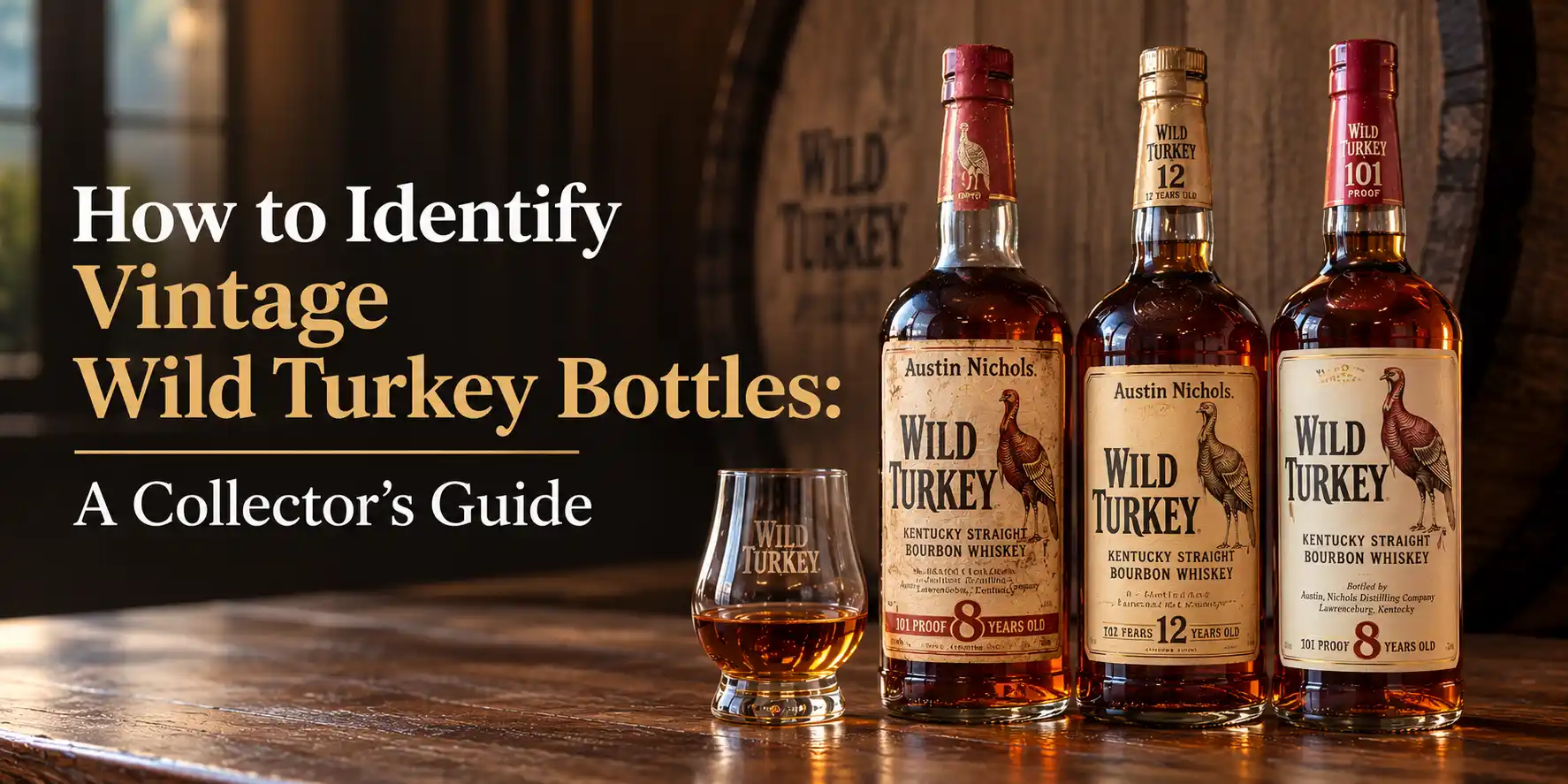
Finding an old Wild Turkey bottle can raise a surprisingly difficult question:
What exactly is it?
The label may say Wild Turkey 101. The bottle may look familiar. It may have been sitting in a cabinet for decades.
But vintage Wild Turkey bottles aren't always as easy to identify as they first appear.
Different production periods, label designs, bottle formats, age statements, proofs, seals, and packaging can separate one release from another. Some older bottles are also known by collector nicknames rather than the names printed on the label.
Two examples are Beyond Duplication and Cheesy Gold Foil, both of which have become recognizable names among people interested in vintage Wild Turkey.
The key to identifying an old bottle is not one particular feature.
It is the combination of details.
And before thinking about what an old Wild Turkey bottle might be worth, the first question should always be:
What bottle do I actually have?
If you want to understand the larger history behind the brand, including Jimmy Russell, Wild Turkey 101, Rare Breed, Kentucky Spirit, and the Russell family legacy, read our guide to Wild Turkey Bourbon: The Kentucky Whiskey That Refused to Change.
Why Vintage Wild Turkey Bottles Can Be Difficult to Identify
Wild Turkey has maintained a recognizable identity for generations, but that doesn't mean every bottle from that history is identical.
Labels changed.
Packaging changed.
Bottle formats changed.
Expressions appeared and disappeared.
Markets also mattered. A bottle produced for export could have packaging details that don't perfectly match a bottle sold domestically during the same broad period.
That is why simply searching for an image of an old Wild Turkey 101 bottle may not be enough.
The better approach is to examine the bottle as a whole.
Look at the label.
Then the proof.
Then the age statement.
Then the bottle itself.
Then the seal, tax strip, fill level, and packaging.
Each detail adds another piece to the identification.
Start With the Label
The label is usually the best place to begin when identifying a vintage Wild Turkey bottle.
Start with the front label, but don't stop there.
The back label can contain information that helps distinguish a release or production period.
Pay attention to the exact wording rather than just the Wild Turkey logo.
Look for:
- Age statements
- Proof
- Product designation
- Distillery information
- Label layout
- Typography
- Government warning language
- Import or export information
Small differences can matter.
A change in typography or wording may not seem significant when you're looking at the bottle casually, but it can become useful when comparing the bottle with known vintage releases.
This is particularly important with older Wild Turkey 101 bottles.
The presence of “101” identifies the proof associated with the expression, but it doesn't automatically identify the exact bottle or production period.
Proof and Age Can Narrow the Possibilities
Two of the most obvious pieces of information on a whiskey bottle are its proof and age statement.
They are also two of the most useful.
Older Wild Turkey releases are often associated with higher-proof bottlings and age statements that help distinguish them from other expressions.
A 12-year-old Wild Turkey, for example, belongs to a different part of the brand's history than a modern bottle without the same age statement.
But proof and age should still be treated as clues rather than a complete identification.
A bottle's label, format, seal, and other characteristics should support the conclusion.
In other words, don't identify a bottle simply because it says:
Wild Turkey — 101 proof — 12 years old.
Look at everything around those details.
The Bottle Shape Can Tell Part of the Story
The glass itself is another piece of the puzzle.
Bottle shapes and formats have changed over the history of American whiskey. Older bottles can have different proportions, closures, glass characteristics, and capacities from more recent releases.
When examining an old Wild Turkey bottle, look at the:
- Overall bottle shape
- Neck
- Closure
- Glass thickness
- Bottle capacity
- Base markings
- Any unusual features in the glass
None of these details should be used in isolation.
But when the bottle shape matches the label, proof, age statement, and other characteristics, the identification becomes much stronger.
This is one reason photographs of the entire bottle are more useful than a photograph of only the front label.
The Seal and Tax Strip Matter
If you're examining an older American whiskey, don't overlook the seal or tax strip.
These details can provide useful clues about the bottle and its condition.
Look carefully at whether the seal is intact and whether the tax strip is still present.
Also note:
- Tears
- Damage
- Missing sections
- Signs of leakage
- Condition around the closure
Don't remove or disturb an old seal just to inspect it.
Its condition is part of the bottle's history.
For an evaluation, a clear photograph of the neck and seal can be much more useful than a verbal description such as “the seal looks old.”
Why Fill Level Matters on an Old Wild Turkey Bottle
One of the first things an experienced buyer or collector may look at is the fill level.
An old bottle can lose some liquid over a long period because of evaporation, storage conditions, or leakage.
That doesn't automatically mean the bottle has no value.
But it does mean the fill level should be documented.
Look at the bottle from the side and note where the liquid sits relative to the shoulders and neck.
A clear photograph makes this much easier to evaluate.
Fill level is particularly important when comparing otherwise similar vintage bottles.
Two bottles from the same general release can present very differently if one has retained a strong fill while another has experienced significant loss.
Beyond Duplication: An Important Vintage Wild Turkey Release
One name that comes up when researching older Wild Turkey bottles is Beyond Duplication.
Beyond Duplication was an early Wild Turkey 12-year-old, 101-proof release introduced in the 1980s.
Its packaging varied across markets, and export bottles continued appearing after the domestic label changed.
That variation is exactly why identifying a Beyond Duplication bottle shouldn't rely on the name alone.
If you believe you have one, examine the entire bottle.
Look at the label.
Check the proof and age statement.
Look at the bottle format.
Examine the seal and tax strip.
Then consider the fill level and any original packaging.
A single matching feature can be interesting.
Several matching features are much more useful.
Cheesy Gold Foil: What Does CGF Mean?
Another name you may encounter when researching vintage Wild Turkey is Cheesy Gold Foil, commonly shortened to CGF.
The name was given by enthusiasts to a vintage Wild Turkey 12-year-old, 101-proof bottling with a distinctive reflective gold label.
The nickname describes the packaging.
It is not an official product name, and it does not refer to an ingredient.
That distinction matters because someone unfamiliar with vintage whiskey terminology may assume CGF is an official expression.
It isn't.
As with Beyond Duplication, the label appearance is only one part of identification.
Bottle size, proof, age statement, seal, fill level, and other details should be considered together before identifying a particular bottle.
Vintage Wild Turkey 101 Is More Than the “101”
Wild Turkey 101 is one of the most recognizable bourbon expressions in American whiskey.
That recognition can actually make vintage identification more complicated.
A bottle marked 101 may immediately look familiar, but the number alone doesn't tell you exactly which generation of the product you're looking at.
Older Wild Turkey 101 bottles can differ in:
- Label design
- Age statement
- Bottle format
- Seal
- Tax strip
- Packaging
- Production period
So if you've inherited an old bottle that appears to be Wild Turkey 101, don't stop at the proof.
Photograph the whole bottle.
The surrounding details may tell you much more.
Condition Is Part of Identification
Once you've established what the bottle appears to be, the next question is its condition.
This matters whether you're simply documenting a family bottle or considering having it evaluated.
Look closely at the label.
Is it clean and intact?
Has it faded?
Is there staining or water damage?
Is the paper peeling?
Then look at the bottle itself.
Are there chips or cracks?
Is the glass cloudy?
Does the closure appear intact?
Is the tax strip complete?
Is the fill level strong?
These details don't necessarily change what the bottle is, but they can affect how it is assessed.
Does an Old Wild Turkey Bottle Automatically Have Value?
No.
This is one of the most important things to understand when researching vintage whiskey.
An old bottle isn't automatically a valuable bottle.
The exact release matters.
Condition matters.
Collector demand matters.
A discontinued expression may attract interest, while another old bottle from the same brand may have much less demand.
That's why broad online searches for phrases such as “old Wild Turkey price” can be misleading.
The age of the bottle is only one piece of the story.
A proper evaluation starts with identifying the specific bottle.
What Determines the Value of a Vintage Wild Turkey Bottle?
Once the bottle has been identified, several factors can influence its market position.
The release itself is important.
So is the production period.
The age statement, proof, rarity, label condition, seal or tax-strip integrity, fill level, and original packaging can all provide useful information.
Current collector demand also matters.
A bottle can have an interesting history without having strong current demand.
Likewise, a particular discontinued release can attract attention because collectors are specifically looking for it.
That is why a generic price guide is rarely enough to establish what an individual bottle is worth.
What Photos Should You Take of an Old Wild Turkey Bottle?
If you're trying to identify a bottle, photographs can often provide more useful information than a written description.
Start with a clear photograph of the entire bottle.
Then photograph the front label closely enough that every word is readable.
Do the same with the back label.
Take a close image of the neck, closure, seal, and tax strip.
Photograph the fill level from the side.
If the bottle has a box, tube, carton, or other original packaging, photograph that too.
Finally, photograph the bottom of the bottle if there are markings that may help with identification.
The goal isn't to create a perfect product photograph.
The goal is to document the bottle exactly as it exists.
Where Can I Get a Vintage Wild Turkey Bottle Evaluated?
If you have identified an older Wild Turkey bottle but aren't sure what to do next, a specialist buyer can review the bottle based on its specific characteristics.
Midwest Whiskey Buyer specifically lists Wild Turkey among the older American whiskey bottles it evaluates. Its submission process asks for clear photos of the bottle, seal, and fill level, with packaging and other details useful for the review.
This can be particularly useful when you have an inherited bottle or an older bottle that has been sitting in a cabinet for years and you aren't sure exactly which release you have.
Where Can I Sell Vintage Wild Turkey?
If the goal is to sell rather than simply identify the bottle, identification should still come first.
You don't need to guess a price based on a random online listing.
You need to establish what the bottle actually is and what condition it is in.
Midwest Whiskey Buyer's Sell Your Bourbon service lists Wild Turkey among the older bottles it purchases and allows sellers to submit bottle photographs for evaluation. The company says its review considers the bottle, seal, fill level, and current collector demand.
That makes the process more straightforward for someone who has a bottle but isn't sure whether it belongs in the collectible market.
Identification Comes Before Valuation
There is an important difference between identifying a bottle and valuing it.
Identification asks:
What is this bottle?
Valuation asks:
What is this specific bottle worth today?
The second question is difficult to answer without the first.
Knowing that you have an old Wild Turkey bottle is a starting point.
Knowing that you have a particular 12-year-old release, understanding its packaging, checking its proof, documenting its seal, and assessing its fill level provides a much stronger foundation for an evaluation.
This is especially important with vintage bottles whose appearance can overlap across different releases.
Vintage Wild Turkey Is a Story Told Through the Bottle
The interesting thing about vintage Wild Turkey is that the bottle itself carries part of the brand's history.
A label can show how the product was presented during a particular period.
A tax strip can point to an earlier era of American whiskey packaging.
A bottle shape can separate one generation from another.
A faded label or reduced fill can tell a different story about how the bottle was stored.
And names such as Beyond Duplication and Cheesy Gold Foil show how collectors have developed their own language around historic Wild Turkey releases.
The more carefully you look, the more information the bottle can reveal.
Final Thoughts on Identifying Vintage Wild Turkey Bottles
Identifying a vintage Wild Turkey bottle isn't about finding one perfect clue.
It's about putting the clues together.
Start with the label.
Check the proof and age statement.
Look at the bottle format.
Examine the seal and tax strip.
Document the fill level.
Pay attention to the condition.
Then compare the complete bottle with known historical releases.
If the bottle appears to be something such as Beyond Duplication or Cheesy Gold Foil, don't rely on the nickname alone. Confirm the surrounding details.
And if you're considering selling the bottle, don't begin with an assumed price.
Begin with identification.
Once you know what you have, you can make a much more informed decision about whether to keep it, research it further, or have it evaluated.
For the broader story behind Wild Turkey's history and the people and releases that shaped the brand, read Wild Turkey Bourbon: The Kentucky Whiskey That Refused to Change.
If you have a bottle you're still unable to identify, submit clear photos to Midwest Whiskey Buyer so the bottle can be reviewed based on its specific characteristics.
.Also Read: top-10-valuable-whiskey-bottles-you-might-own' /how-much-is-my-whiskey-worth/ /antique-whiskey-bottles-price-guide/ /how-much-is-my-old-bourbon-worth/ /bourbon-oversupply / /where-to-sell-my-whiskey-in-2026 /most-valuable-whiskey-bottles-to-sell / /selling-whiskey-vs-auctioning-it-pros-and-cons/ /stitzel-weller-old-fitzgerald-bottle-identification-guide / very-old-fitzgerald-vs-old-fitzgerald-bottled-in-bond /, wild-turkey-bourbon-the-kentucky-whiskey-that-refused-to-change


