

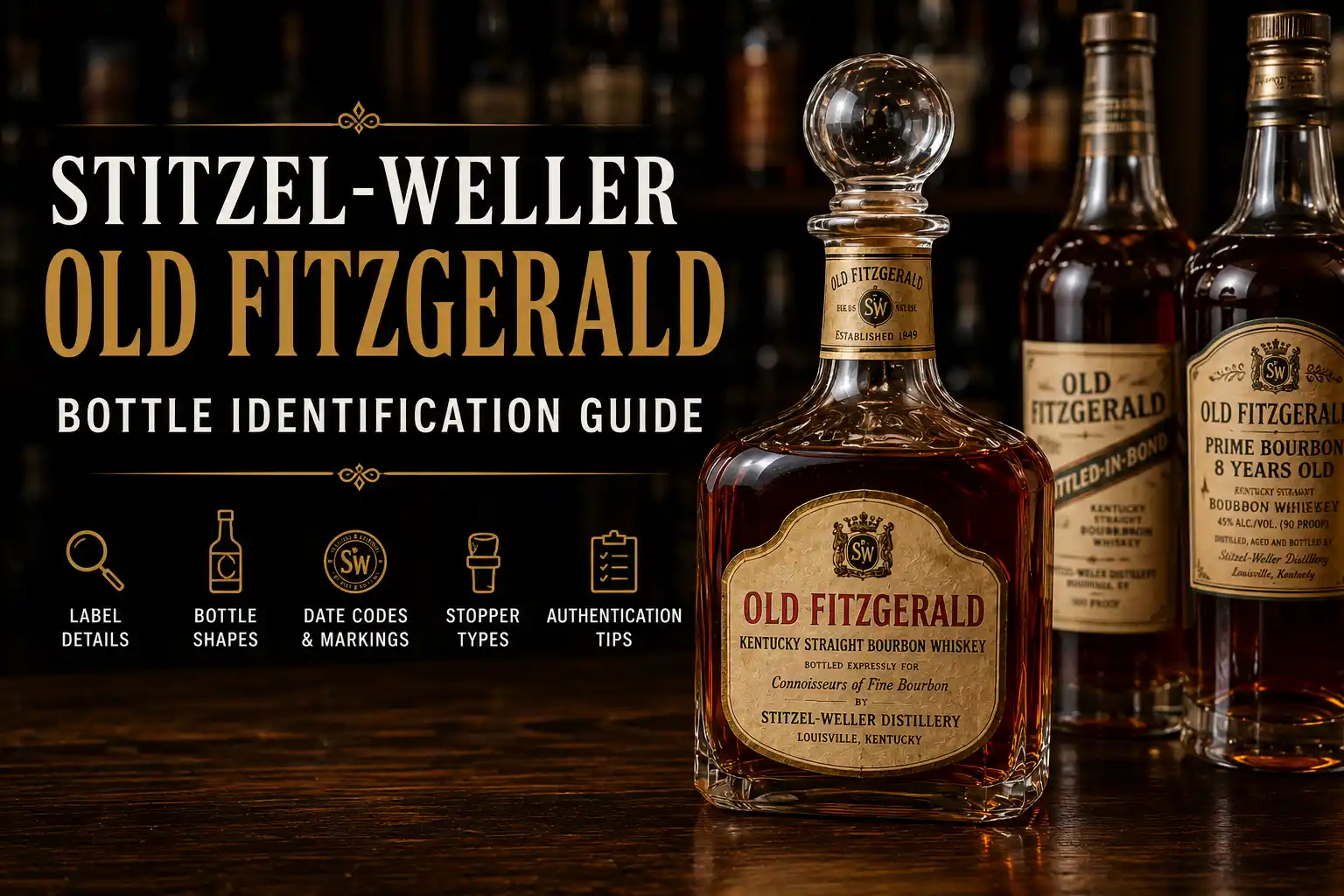
"Old Fitzgerald" has been on shelves continuously since the 1870s, which is exactly what makes it confusing to
identify. The bottle in front of you could be true Stitzel-Weller-era stock from the distillery that also made the
original Pappy Van Winkle whiskey or it could be a modern bottle from Heaven Hill, which has owned and
produced the Old Fitzgerald brand since 1999 and uses its own recipe and distillate. Same name on the label,
very different bottle. Here's how to tell which one you're holding.
Check the label for "DSP-KY-16" Stitzel-Weller's distiller code, required on Bottled-in-Bond labels.
Check the neck for an intact federal tax strip, which confirms the bottle is from 1985 or earlier. Check
the bottom of the bottle for embossed codes, which can help narrow the era even without a label. If
none of those are conclusive, photograph everything and get a second opinion before assuming either way.
Why This Distinction Matters
The Stitzel-Weller distillery opened in Louisville in 1935. In 1972, after the distillery was sold to Norton Simon, it
was officially renamed the "Old Fitzgerald Distillery" even though collectors still refer to the whiskey itself as
Stitzel-Weller. The distillery closed for good in 1992, and production of the wheated bourbon line shifted to the
newly built Bernheim Distillery. In 1999, the Old Fitzgerald brand along with the Bernheim Distillery itself
was sold to Heaven Hill, which still owns and produces it today. The Weller brands went a different direction
entirely, ending up with Buffalo Trace.
So "Stitzel-Weller Old Fitzgerald" specifically means whiskey distilled before the shift away from the original
Shively distillery not anything currently on a liquor store shelf with that name on it.
Step 1: Look for the DSP Number
DSP stands for Distilled Spirits Plant a code the federal government assigns to every distillery. "Stitzel-Weller's"
was DSP-KY-16. On Bottled-in-Bond labels, the law requires the DSP number to be printed, so if you see "DSP-KY-
16" on the label, that'ss about as close to confirmed as it gets.
Non-Bottled-in-Bond bottles aren't required to show it, so its absence doesn't automatically rule Stitzel-Weller
out — it just means you'll need the other checks below.
Step 2: Check for a Federal Tax Strip
Federal law required a paper tax strip across the cap and neck of every bottle of spirits sold in the U.S. through
1985. If your bottle still has an intact strip, you know immediately it was bottled in 1985 or earlier which puts
it comfortably within the Stitzel-Weller era. No strip doesn't mean it's not Stitzel-Weller; it just means the bottle
is from 1985 or later, when the requirement ended.
Step 3: Check the Bottom of the Bottle
Older bottles frequently have codes embossed into the glass itself plant codes and mold numbers from the
glass manufacturer. These won't tell you the brand, but combined with the label details, they can help narrow
down roughly when a bottle was made, which is useful when the label itself is worn or incomplete.
Step 4: Cross-Check the UPC — Carefully
UPC codes on Old Fitzgerald bottles changed more than once as the brand changed hands between the 1990s
and today, and different sources online don't always agree on the exact numbers. Don't rely on a UPC you saw
quoted somewhere else look up the specific code on your bottle against a UPC database yourself, and treat it
as one data point alongside the DSP number and tax strip rather than a stand-alone answer.
The Ownership Timeline
Year What Happened
1935 Stitzel-Weller Distillery opens in Louisville.
1965 Julian "Pappy" Van Winkle dies; his son takes over.
1972 Distillery sold to Norton Simon and renamed the Old Fitzgerald Distillery.
1992 Stitzel-Weller distillery closes; wheated bourbon production shifts to the new Bernheim
Distillery.
1999 Diageo sells the Bernheim Distillery and the Old Fitzgerald brand to Heaven Hill. Weller
brands go to Buffalo Trace instead.
Today Heaven Hill owns and produces Old Fitzgerald, distilled at Bernheim a different
distillate from the original Stitzel-Weller-era whiskey.
Common Mix-Ups
• Bottles from the mid-to-late 1990s can be genuinely confusing the distillery itself had closed by 1992, but
existing Stitzel-Weller stock was still being used in bottling for a few years afterward. Age alone won't settle
it; the label and tax-strip checks matter more here than the decade printed on anything.
• Weller and Old Fitzgerald came out of the same distillery but are separate brands. A Weller bottle from the
Stitzel-Weller era is not "Old Fitzgerald" even though the production history overlaps.
• Modern Old Fitzgerald (Heaven Hill, post-1999) sometimes uses label designs that echo the older look.
Don't judge by label style alone the DSP number and tax strip are the real tell.
Tapped: sell whiskey online' /sell-your-bourbon/ /sell-rare-whiskey-online-in-the-usa/
.Also Read: top-10-valuable-whiskey-bottles-you-might-own' /how-much-is-my-whiskey-worth/ /antique-whiskey-bottles-price-guide/ /how-much-is-my-old-bourbon-worth/ /bourbon-oversupply / /where-to-sell-my-whiskey-in-2026 /most-valuable-whiskey-bottles-to-sell / /selling-whiskey-vs-auctioning-it-pros-and-cons/


