

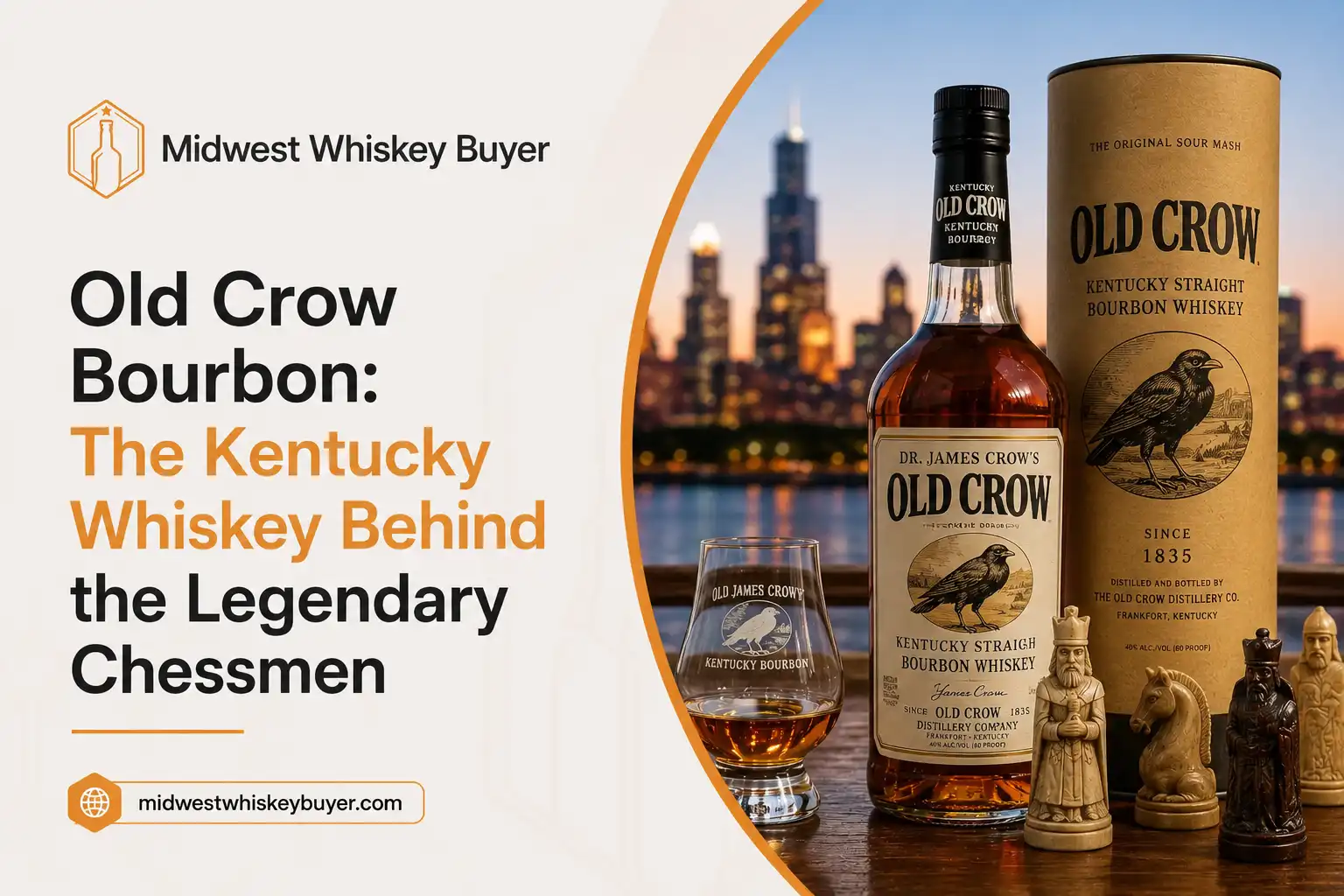
Old Crow Bourbon has a story that goes far beyond the bottle sitting on a liquor shelf.
The name is tied to Dr. James C. Crow, a 19th-century Kentucky distiller whose work helped standardize the sour mash process. Decades later, the Old Crow name became associated with one of the most unusual whiskey releases ever made: the Old Crow Chessmen, a 32-piece ceramic chess set filled with 10-year-old bourbon.
That contrast is what makes Old Crow interesting.
The modern expression is known as an accessible, value-oriented bourbon. The historic Old Crow associated with National Distillers, however, is highly regarded by vintage whiskey collectors, with the 1969 Chessmen release sitting among the most recognizable examples.
Here's how the Old Crow story developed—from James Crow and sour mash to the Old Crow Chessmen and the bourbon available today.
What Is Old Crow Bourbon?
Old Crow Bourbon is a Kentucky straight bourbon whiskey named in honor of James C. Crow, a Scottish immigrant and distiller associated with the development and documentation of the sour mash process.
The brand has gone through several distinct periods of production. Today's Old Crow is a much different whiskey from the bottles produced during the National Distillers era, which is an important distinction when discussing Old Crow bourbon history.
Modern Old Crow is positioned as an affordable, straightforward bourbon. Its official brand profile highlights honey, candy corn, citrus, vanilla, caramel, and oak, while the standard expression is bottled at 80 proof.
But the Old Crow name once carried a very different reputation.
To understand that history, you have to start with the man behind the name.
Who Was James C. Crow?
James C. Crow arrived in Kentucky during the 1830s and became an influential distiller in the Frankfort area.
Rather than treating whiskey production simply as a craft passed down through tradition, Crow approached distilling with a more systematic mindset. He paid close attention to fermentation and production consistency and became closely associated with the sour mash method.
Sour mash does not mean the finished bourbon tastes sour.
Instead, a portion of material from a previous fermentation is incorporated into a new mash. The process helps establish a more controlled fermentation environment and contributes to consistency in whiskey production.
Crow's work became an important part of Kentucky's distilling history, and the Old Crow brand eventually carried his name across generations of bourbon production. The World Chess Hall of Fame also traces the Old Crow story directly back to James Crow's work in 1830s Frankfort.
His influence is one reason James Crow bourbon remains an important search and research topic for anyone exploring the origins of Old Crow.
The Original Old Crow Wasn't the Same as Today's Bourbon
This is where the Old Crow story gets complicated.
Old Crow grew into a major American whiskey brand, particularly during the period when National Distillers controlled the brand. The whiskey produced during that era developed a strong reputation among bourbon drinkers.
Over time, however, Old Crow's position changed.
The brand eventually became part of Jim Beam after National Distillers was acquired in 1987. The production history that followed was different from the earlier National Distillers era, which is why vintage Old Crow and modern Old Crow are often discussed almost as two separate categories by whiskey enthusiasts.
That distinction becomes particularly important when looking at the Old Crow Chessmen.
Old Crow Chessmen: When Bourbon Became a Chess Set
In 1969, Old Crow released one of the most unusual bourbon packages ever created.
Instead of putting the whiskey into ordinary glass bottles, National Distillers packaged the bourbon inside 32 ceramic chess-piece decanters.
There were pawns, bishops, knights, rooks, a queen, and a king—enough pieces to form a complete chess set.
The pieces were individually designed and hand-glazed in contrasting colors, with the full set ranging from approximately 12 to 15½ inches in height. Each decanter contained Old Crow bourbon.
And the concept went further.
A complete Old Crow Chessmen set could be paired with a 45-by-45-inch deep-pile chessboard rug, turning the bourbon collection into an actual playable chess set. Contemporary advertising described the pieces as limited-edition ceramic works of art and promoted the board as part of the overall experience.
It was whiskey packaging designed to be kept, displayed, and talked about.
Decades later, that idea has made the Chessmen one of the most recognizable pieces of vintage bourbon memorabilia.
What Bourbon Was Inside the Old Crow Chessmen?
The whiskey inside the Chessmen was not the same as today's standard Old Crow.
The 1969 release contained 10-year-old Old Crow bourbon bottled at 86 proof, or 43% ABV. It was produced during the National Distillers era.
That difference matters.
Today's standard Old Crow is an 80-proof bourbon designed for accessible everyday drinking. The Chessmen represented an older, 10-year-old expression that has become highly sought after among vintage bourbon enthusiasts.
The whiskey's age is only part of the appeal.
The production era, unusual ceramic packaging, historical context, and scarcity all contribute to the interest surrounding the Chessmen.
Why Are Old Crow Chessmen So Collectible?
The Old Crow Chessmen are unusual even by the standards of vintage whiskey collecting.
A normal vintage bourbon bottle is one object.
A complete Chessmen set is 32 individual decanters, each representing a piece of a chess game.
That alone makes a complete set difficult to assemble.
The ceramic pieces are also visually distinctive. Their size and design make them immediately recognizable as something different from conventional bourbon packaging.
But collectors aren't interested only in the ceramic.
They're interested in the bourbon inside.
Vintage whiskey enthusiasts have developed a strong reputation for the 10-year-old Old Crow found in the Chessmen. Some respected bourbon writers and collectors have ranked it among the most impressive vintage bourbons they've tasted, although experiences can vary significantly from one decanter to another.
That last point is important.
A bottle from the 1960s has spent decades in storage. Fill level, evaporation, cork condition, and storage history can all affect the final whiskey.
So two Chessmen pieces from the same original release don't necessarily taste identical today.
What Does Old Crow Chessmen Bourbon Taste Like?
Vintage Old Crow Chessmen bourbon has developed a reputation for being much richer and more complex than the modern Old Crow expression.
Tasting reports have described combinations of maple, caramel, vanilla, butterscotch, toffee, oak, pepper, and dark sweetness. One recent tasting of a 1969 Chessmen piece described a rich, sweet profile with maple, creamy vanilla, butterscotch, raisins, toffee, caramel, and a long oak-driven finish.
Other vintage reviews have similarly noted deep color, caramel, oak, baking spice, and a long finish.
However, vintage whiskey should always be approached with some caution.
Decades of storage can change a bottle dramatically. A poorly sealed decanter may have experienced evaporation, while another bottle stored under better conditions may retain considerably more of its original character.
That's one reason vintage Old Crow bourbon reviews can vary so much.
Old Crow Chessmen and the Rise of Whiskey Decanters
The Chessmen were part of a broader period in American whiskey when distillers experimented heavily with decorative packaging.
During the 1960s and 1970s, whiskey brands increasingly used elaborate ceramic decanters and collectible packaging to make their products stand out.
Old Crow took the idea considerably further.
Instead of creating a single decorative bottle, the brand turned the entire package into a collection.
The consumer could buy individual pieces, collect all 32, and obtain the chessboard separately.
That approach gave the product multiple identities at once:
It was bourbon.
It was a collectible.
It was home décor.
And it was a chess set.
That combination is a major reason the Old Crow Chessmen remain memorable long after their original release.
What Happened to Old Crow Bourbon?
The Old Crow brand eventually entered a very different period.
After the National Distillers era, the brand was acquired by Jim Beam in 1987. The historic production associated with the old Old Crow Distillery did not simply continue unchanged.
Instead, the brand entered a modern production model and became positioned much more strongly as an affordable bourbon.
That transition is one of the reasons vintage Old Crow attracts so much attention.
The bottles produced during the National Distillers period are part of a different chapter of American whiskey history from the modern expression.
For collectors, the phrase “old Old Crow” can therefore mean something very specific.
It refers to whiskey from an earlier production era—not simply a bottle of modern Old Crow that happens to have been sitting on a shelf for several years.
What Does Modern Old Crow Bourbon Taste Like?
Modern Old Crow is considerably simpler than the vintage Chessmen bourbon associated with the brand's collecting community.
The current brand profile describes honey, candy corn, and ripe citrus on the nose, with vanilla, caramel, and oak on the palate.
The standard bottle is 80 proof, making it relatively approachable compared with many contemporary bourbon releases that are bottled at higher proof.
It's not designed to compete directly with barrel-proof bourbon, single-barrel releases, or heavily aged premium expressions.
Its appeal is different.
Modern Old Crow is about accessibility and familiarity.
Vintage Old Crow is about history, production era, and the character of an older whiskey.
Putting the two side by side is therefore less a direct comparison than a look at how American bourbon changed over several decades.
Is Old Crow Bourbon Good?
Whether Old Crow Bourbon is good depends on what you're looking for.
If you're searching for a complex bourbon with substantial age, high proof, and intense barrel character, the modern expression probably isn't the natural starting point.
If you're looking for an affordable bourbon with a straightforward profile for casual drinking or mixing, it occupies a different and more practical role.
The Old Crow Chessmen are another matter entirely.
Vintage Chessmen bourbon belongs to the world of collectible and “dusty” whiskey, where age, provenance, storage conditions, and production history become just as important as the liquid itself.
That distinction is worth remembering before comparing modern Old Crow with vintage bottles.
Old Crow Bourbon for Cocktails
Modern Old Crow's approachable profile makes it suitable for simple bourbon cocktails.
Old Fashioned
An Old Fashioned gives bourbon a chance to work with sugar, bitters, and citrus while bringing more structure to a relatively straightforward whiskey.
Bourbon & Cola
A simple bourbon-and-cola is another natural use for an affordable bourbon where the whiskey doesn't need to dominate the entire drink.
Bourbon & Ginger Ale
Ginger ale adds sweetness and spice and works well with lighter bourbon profiles.
Vintage Old Crow Chessmen bourbon is a different proposition.
Given its historical value and scarcity, collectors generally treat it as a whiskey to explore on its own rather than as cocktail stock.
Old Crow Then and Now
The easiest way to understand Old Crow is to separate the brand into its major eras.
There is the James C. Crow era, when the brand's identity became associated with sour mash and a more systematic approach to distilling.
There is the National Distillers era, when Old Crow became a major American whiskey brand and produced memorable releases such as the 1969 Chessmen.
And there is the modern era, following the brand's acquisition by Jim Beam, when Old Crow became a more value-oriented bourbon.
The bottle may carry the same name.
The whiskey does not represent the same period.
That is what makes researching Old Crow bourbon history so interesting.
Why Old Crow Chessmen Still Matter
The Old Crow Chessmen aren't important simply because they look unusual.
They capture a particular moment in American whiskey history.
In 1969, a major bourbon brand took 10-year-old whiskey, placed it inside 32 ceramic chess pieces, and created a product that could become an entire chess set.
That kind of packaging would be difficult to imagine in today's bourbon market.
The Chessmen also provide a physical connection to the National Distillers era of Old Crow. Each surviving piece represents a small part of that period's production and marketing culture.
For bourbon collectors, that's part of the appeal.
You're not simply holding an old bottle.
You're holding a piece of the brand's history.
Old Crow Bourbon and the Meaning of Vintage Whiskey
The Old Crow story also illustrates why vintage bourbon cannot always be evaluated using modern expectations.
Today's bourbon market places enormous emphasis on proof, age statements, single barrels, limited releases, and highly detailed tasting profiles.
Vintage whiskey works differently.
The distillery matters.
The production era matters.
The bottle design matters.
The storage history matters.
And sometimes the story surrounding the bottle becomes inseparable from the whiskey itself.
Old Crow Chessmen are a perfect example.
The bourbon is important.
But so is the fact that the bourbon was packaged as a chess set in 1969.
The Bottom Line on Old Crow Bourbon
Old Crow Bourbon may look like a simple value bourbon today, but its history is anything but simple.
The name comes from James C. Crow, a Kentucky distiller whose work became associated with the sour mash process.
The brand later became an important American whiskey under National Distillers.
Then came the 1969 Old Crow Chessmen, a limited-edition release featuring 32 ceramic chess-piece decanters filled with 10-year-old, 86-proof bourbon.
Those Chessmen have since become highly collectible, not only because of their unusual design but also because of the reputation surrounding the vintage bourbon inside them.
Modern Old Crow tells a different story.
It's an accessible 80-proof bourbon with a straightforward profile built around familiar notes of honey, vanilla, caramel, citrus, and oak.
The two versions shouldn't be confused.
One represents modern value bourbon.
The other represents a fascinating period of American whiskey history.
And somewhere between those two sits the reason Old Crow remains worth talking about:
a bourbon brand whose most memorable legacy may be the 32-piece chess set it once put on the market.
Tapped: sell whiskey online' /sell-your-bourbon/ /sell-rare-whiskey-online-in-the-usa/
.Also Read: top-10-valuable-whiskey-bottles-you-might-own' /how-much-is-my-whiskey-worth/ /antique-whiskey-bottles-price-guide/ /how-much-is-my-old-bourbon-worth/ /bourbon-oversupply / /where-to-sell-my-whiskey-in-2026 /most-valuable-whiskey-bottles-to-sell / /selling-whiskey-vs-auctioning-it-pros-and-cons/ /stitzel-weller-old-fitzgerald-bottle-identification-guide / very-old-fitzgerald-vs-old-fitzgerald-bottled-in-bond /


