
Vintage Wild Turkey bottles can tell you a surprising amount about American bourbon history.
A small change in a front label, a two-digit mark molded into the glass, a printed code on the foil, or the wording on the back label can help narrow down when a bottle was made. For collectors and bourbon enthusiasts, those details are often more useful than simply guessing from the bottle's appearance.
The challenge is that Wild Turkey bottle dating is not based on one code system. The brand used different labeling, bottling, and coding conventions over several decades, and some systems overlapped. That means identifying an older Wild Turkey bottle requires looking at several clues together rather than relying on one number.
This guide explains how to date vintage Wild Turkey bottles, what the major label changes mean, and which details collectors should examine first.
A Brief History of Wild Turkey Bourbon
The Wild Turkey brand has a long history in Lawrenceburg, Kentucky, but the brand did not begin as a single-distillery operation.
Wild Turkey's official history traces the Lawrenceburg distilling story back to the Ripy family, while the brand itself emerged in the 20th century. Austin Nichols developed the Wild Turkey brand, and the Ripy distillery became central to its production. Austin Nichols purchased the Lawrenceburg distillery in 1972, after which Wild Turkey production became closely tied to the site.
That 1972 milestone is particularly useful when identifying older bottles.
According to Whiskey ID's Wild Turkey timeline, the wording at the bottom of the front label changed around that period from “New York, NY” to “Lawrenceburg, Kentucky.” That makes label text an important historical clue when examining a vintage bottle.
Wild Turkey also has an unusually strong connection with Master Distiller Jimmy Russell, who began working at the Lawrenceburg distillery in 1954. He became one of the defining figures in the brand's history and remains closely associated with Wild Turkey's traditional bourbon style.
Why Dating a Vintage Wild Turkey Bottle Can Be Difficult
One of the biggest mistakes collectors make is assuming that every Wild Turkey bottle can be dated from a single printed number.
It can't.
Wild Turkey used multiple date-code formats over the years, particularly from the 1990s onward. Some codes appeared on the back label or foil, while later codes were laser-etched directly onto the bottle.
Specialist Wild Turkey research documents several different formats, including printed dates, L1-style codes, L-1-style codes, longer L-number formats, and later laser codes. These systems were used during different periods, with some overlap.
That means the format of the code itself is part of the dating process.
You shouldn't simply see a number and assume it represents the bottling year.
How to Date a Vintage Wild Turkey Bottle
The best approach is to work from several clues:
Start with the label.
Then inspect the bottle's glass.
After that, look for a date code.
Finally, compare all of those details with the known Wild Turkey timeline.
This approach is much more reliable than using any one feature by itself.
Step 1: Examine the Front Label
The front label is one of the most useful places to start.
Look at:
- The exact Wild Turkey name
- The proof
- Any age statement
- The phrase used for the product
- Austin Nichols branding
- The illustration or style of the turkey
- The location wording at the bottom of the label
- Overall label design
Older Wild Turkey bottles can look dramatically different from current packaging.
One historically useful change occurred in the late 1950s, when the bottom of the front label changed from “Brooklyn – New York” to “New York, NY.” Around 1972, the wording changed again to “Lawrenceburg, Kentucky” after Austin Nichols acquired the Lawrenceburg distillery.
These details won't necessarily give you an exact bottling date, but they can help establish a reasonable time period.
Step 2: Check the Age Statement
Age statements can be extremely useful when dating older Wild Turkey bottles.
For many years, Wild Turkey 101 was strongly associated with an 8-year age statement. Whiskey ID's historical timeline notes that the 8-year statement was removed around 1992, with the label changing to “Old No. 8 Brand.” In 1998, that “Old No. 8 Brand” wording was removed as well, leaving the Wild Turkey 101 branding that became familiar to modern consumers.
That makes an age statement more than a tasting detail.
It can be a historical marker.
For example, a bottle labeled Wild Turkey 101 with an explicit 8-year statement belongs to a different labeling period from a bottle carrying the later “Old No. 8 Brand” wording.
Step 3: Look for Austin Nichols on the Label
The Austin Nichols name is another useful clue when examining older Wild Turkey bottles.
Older bottles often give the company much more visible placement on the front label. Over time, the prominence of Austin Nichols changed.
Collectors have used these label differences to distinguish bottles from different periods, particularly around the transition from older full-color labeling to later designs.
This is why label comparison is so helpful when identifying a vintage Wild Turkey bottle.
Two bottles can both say “Wild Turkey 101,” yet belong to different production periods.
Step 4: Examine the Turkey Illustration
The turkey image itself changed over time.
Specialist bottle research identifies a major Wild Turkey label change around 1999, when the packaging used a left-facing, full-color turkey in profile. Around 2011, the design changed to a brown-and-white sketched turkey, and Austin Nichols was moved into smaller text near the bottom. Another significant label change followed around 2015.
These visual changes can help narrow down the era of a bottle even when a clear date code is difficult to find.
They are especially useful when used alongside the age statement, proof, and bottle code.
Step 5: Check the Bottom of the Bottle
For older Wild Turkey bottles, the bottom of the glass can be particularly important.
Specialist Wild Turkey bottle research notes that bottles from the period before approximately 1992 commonly have a two-digit date stamp molded into the glass.
For example, a stamp reading “87” can indicate that the glass bottle was manufactured in 1987.
But there is an important distinction:
A glass manufacture date is not necessarily the same as the bourbon's bottling date.
A bottle could have been manufactured before it was filled.
That means the glass stamp is best treated as one piece of evidence rather than proof of the exact bottling date.
Step 6: Look for Printed Dates and Bottle Codes
For bottles from the 1990s and later, the code on the back label, foil, or bottle can be much more informative.
Wild Turkey's documented code systems include several formats.
Printed MM/DD/YY Dates
During part of the 1990s, Wild Turkey used a straightforward date format such as:
03/23/94
This indicates March 23, 1994.
These dates could appear on the back label or foil and may also be accompanied by bottling-time information.
L1-Style Codes
A format such as:
L12358
has been associated with the early 1990s.
Specialist research interprets the code as a year digit followed by a Julian day. In this example, the code corresponds to December 23, 1992.
L-1-Style Codes
Another format used during the 1990s looked like:
L-15-220
This system again incorporates a year digit and Julian day, allowing the code to be interpreted as August 8, 1995.
Longer L-Number Formats
Later in the 1990s and into the early 2000s, Wild Turkey used longer codes beginning with an “L.”
These can be more difficult to interpret because not every portion of the code has been conclusively established. Specialist research notes that these formats should be interpreted using their known production period rather than assuming every character has a confirmed meaning.
That is an important E-E-A-T point for anyone researching vintage whiskey:
Not every bottle code can be decoded with absolute certainty.
A responsible identification should distinguish between confirmed information and collector-based interpretation.
Step 7: Pay Attention to Where the Code Appears
The location of the code can help determine which dating system you're looking at.
Older Wild Turkey bottles may have date information printed on the back label or foil enclosure.
Later bottles moved toward laser coding directly onto the glass, often near the bottom or below the back label.
So when inspecting a bottle, don't stop after checking the label.
Turn it around.
Look underneath.
Check the glass around the base.
Use a flashlight if necessary.
Some older markings can be surprisingly difficult to see.
Wild Turkey Bottle Dating After 2006
Around 2006, Wild Turkey's bottling operation moved to Lawrenceburg, Indiana, and the coding format changed.
Specialist bottle research identifies a laser-coded format beginning around this period, followed by additional coding formats in the late 2000s, 2010s, and early 2020s.
This is another reason why identifying the code format first is so important.
A code that looks confusing on a 1990s bottle may be interpreted very differently from one found on a post-2006 bottle.
The physical location and structure of the code provide context.
Wild Turkey 101 Bottle Dating
When collectors talk about vintage Wild Turkey bottles, Wild Turkey 101 comes up frequently.
That is understandable.
Wild Turkey 101 has been one of the brand's defining expressions for decades, and older versions can show significant differences in labeling and presentation.
Wild Turkey's current official product information describes the modern 101 as a Kentucky straight bourbon aged between six and eight years and bottled at 101 proof. The brand also emphasizes its use of American white oak barrels with a deep char.
But older bottles may have different age statements and label language.
One especially important transition occurred around 1992, when the traditional 8-year age statement was removed from the label and replaced by “Old No. 8 Brand.” The “Old No. 8 Brand” wording was later removed around 1998.
So an older Wild Turkey 101 bottle should not automatically be judged against today's label.
The historical packaging is part of the identification.
Vintage Wild Turkey 12 Year and the “Beyond Duplication” Label
The older Wild Turkey 12 Year 101 proof bottles are another area where label details can be especially helpful.
Historical bottle research identifies several different label designs for this expression.
The “Beyond Duplication” wording is particularly associated with older Wild Turkey 12-year bottles, and the label evolved over time. Specialist collector sources identify an important group of 12-year bottles from the 1980s, followed by additional label changes in the early 1990s and later export versions.
This illustrates a broader point about vintage bourbon:
A product name alone isn't always enough to identify a bottle's era.
The exact label design matters.
What Is a “Cheesy Gold Foil” Wild Turkey Bottle?
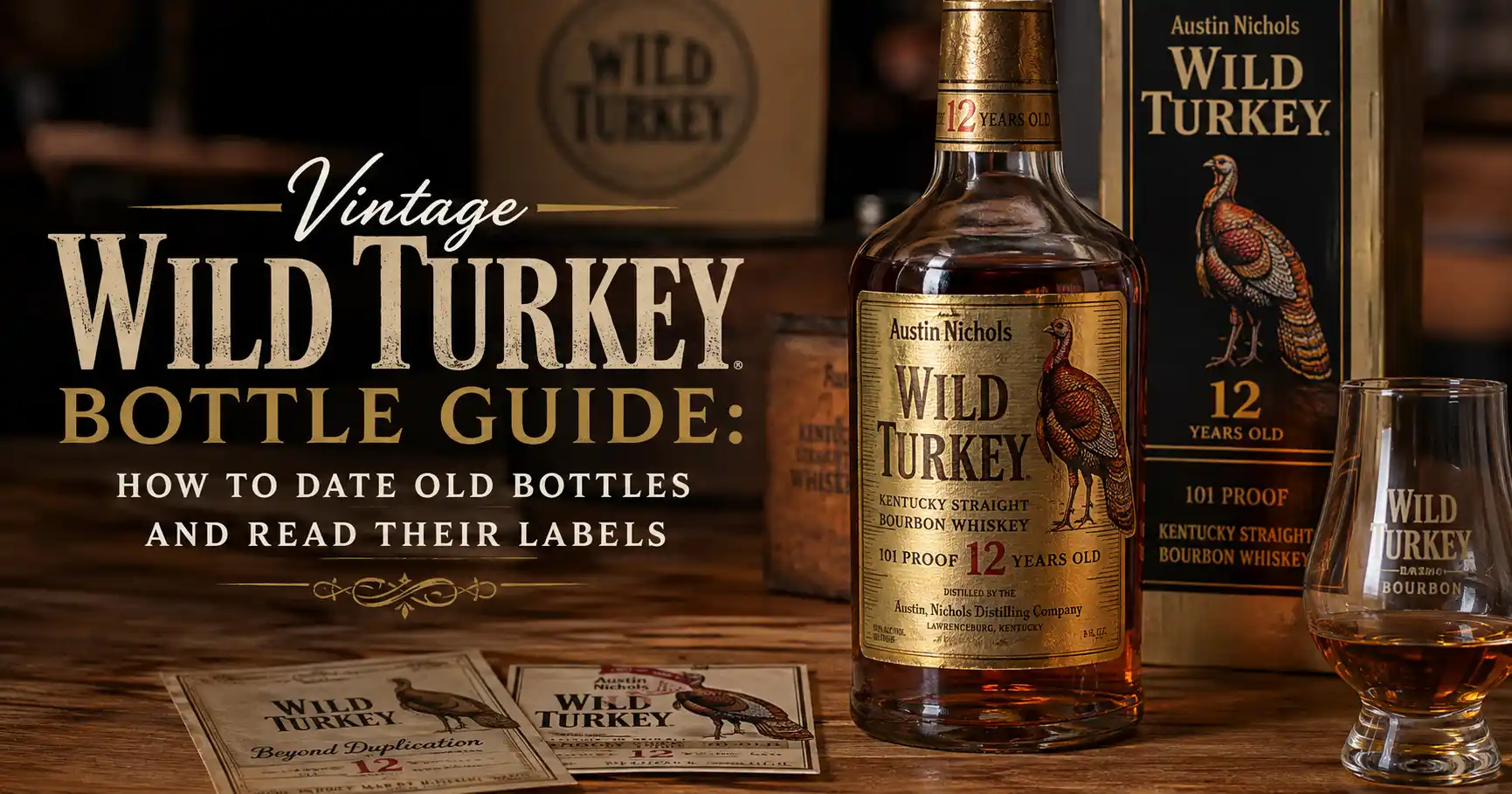
Among vintage Wild Turkey collectors, “Cheesy Gold Foil” refers to a distinctive group of older Wild Turkey 12 Year 101 Proof bottles generally associated with the 1980s.
The nickname comes from the bottle's recognizable gold foil-style label and packaging, which followed the earlier “Beyond Duplication” design. Despite the informal collector nickname, these bottles are an important part of Wild Turkey's vintage history and are highly sought after by collectors.
Cheesy Gold Foil bottles are generally associated with the mid-to-late 1980s, although packaging changes can overlap between production periods. For that reason, the front label alone should not be used to assign an exact bottling year.
How to Identify a Cheesy Gold Foil Wild Turkey Bottle
When examining a suspected Cheesy Gold Foil bottle, collectors should look at several details together, including:
- The gold-colored front label and foil-style design
- The 12 Year age statement
- The 101 Proof designation
- Austin Nichols wording
- Markings molded into the bottle base
- Tax strips and closure details
- Any printed production or date codes
- Original box or other packaging, if available
These details can help distinguish Cheesy Gold Foil bottles from earlier Beyond Duplication releases and later Wild Turkey 12 Year label designs.
Why Bottle Condition Matters
Because these bottles are now several decades old, condition can also be relevant when evaluating a vintage Wild Turkey bottle.
Fill level, label condition, closure integrity, tax markings, and original packaging can all provide useful identification clues and may influence collector interest.
If you have an old Wild Turkey 12 Year Cheesy Gold Foil bottle, photographs can make identification much easier. Clear images of the front label, back label, bottle base, cap, fill level, and original box or packaging can help narrow down the likely production period and specific version.
Wild Turkey Kentucky Spirit: Another Helpful Dating Clue
Wild Turkey Kentucky Spirit is useful for collectors because the product itself has identifiable packaging changes.
Wild Turkey describes Kentucky Spirit as a single-barrel bourbon bottled at 101 proof, with the barrel number, date, and warehouse number handwritten on the neck label.
Historical bottle references identify different cap styles over the years.
Early Kentucky Spirit bottles used a pewter cap. Later versions changed to different wood-cap designs, giving collectors another visual clue when identifying an older bottle.
When dating a Kentucky Spirit bottle, the neck label and cap can therefore be just as useful as the main front label.
What Does the Proof Tell You?
Proof can help narrow down what you're looking at, but it usually shouldn't be used by itself to establish a bottling year.
Wild Turkey has a long history with 101 proof bourbon, which became an important part of the brand's identity.
There were also lower-proof expressions and product changes over time.
The historical timeline notes that an 80-proof Wild Turkey bourbon was added to the line in 1974.
That means the proof printed on the label can provide historical context, particularly when combined with the product name and age statement.
Don't Assume an Old Bottle Was Distilled at Lawrenceburg
This is one of the most important historical details for vintage Wild Turkey collectors.
Wild Turkey's earliest production history involved bourbon sourced from multiple distilleries.
According to specialist historical research, before Austin Nichols purchased the Lawrenceburg distillery in 1972, Wild Turkey bourbon could have been distilled at several different facilities. After the acquisition, Wild Turkey production became centered at Lawrenceburg.
So a very old Wild Turkey bottle does not automatically mean the whiskey inside was distilled at the modern Lawrenceburg operation.
That distinction matters when discussing historical bottles.
Common Mistakes When Dating Vintage Wild Turkey Bottles
One common mistake is assuming the number on the bottle is automatically the bottling year.
Another is treating the glass manufacture date as the exact date the bourbon was bottled.
Some collectors also focus too heavily on the front label while ignoring the back label, neck, tax markings, bottle base, and packaging.
And one of the biggest mistakes is assuming that a label design appeared on only one specific date.
Packaging transitions often overlap.
The safest approach is to compare multiple clues and establish a likely date range rather than forcing an exact year when the evidence doesn't support one.
How to Identify Your Vintage Wild Turkey Bottle
When you're examining an old Wild Turkey bottle, photograph the entire bottle before trying to interpret it.
Take a clear photo of the:
- Front label
- Back label
- Neck label
- Cap or closure
- Bottle base
- Embossed or laser-etched markings
- Fill level
- Any box or original packaging
Also record the bottle's:
- Proof
- Age statement
- Product name
- Bottle size
- Distillery or company wording
These details make identification much easier.
A clear photograph can often reveal more than a vague description such as “I have an old Wild Turkey bottle.”
How Collectors Should Think About Wild Turkey Bottle Dates
Dating vintage Wild Turkey is best treated as an identification process, not a guessing game.
Start with the historical period.
Look at the label wording.
Check the age statement.
Inspect the turkey artwork.
Examine the bottle base.
Find the code.
Determine which code format you're looking at.
Then compare all of those details against the known Wild Turkey timeline.
This approach is particularly important because Wild Turkey went through major changes in ownership, production, labeling, packaging, and bottling operations over the decades.
Final Thoughts
A vintage Wild Turkey bottle is more than an old bottle of bourbon.
The label can reflect a specific period in the brand's history. The age statement can reveal how the product was presented at the time. The wording on the front label can help place a bottle within a particular era. And the code on the label, foil, or glass can provide an additional dating clue.
The key is not to rely on one detail.
Read the label. Check the glass. Find the code. Understand the history. Then compare the evidence.
For collectors and bourbon enthusiasts across the United States, that is the most reliable way to approach vintage Wild Turkey bottle identification and dating.
Tapped: sell whiskey online' /sell-your-bourbon/ /sell-rare-whiskey-online-in-the-usa/
.Also Read: top-10-valuable-whiskey-bottles-you-might-own' /how-much-is-my-whiskey-worth/ /antique-whiskey-bottles-price-guide/ /how-much-is-my-old-bourbon-worth/ /bourbon-oversupply / /where-to-sell-my-whiskey-in-2026 /most-valuable-whiskey-bottles-to-sell / /selling-whiskey-vs-auctioning-it-pros-and-cons/ /stitzel-weller-old-fitzgerald-bottle-identification-guide / /very-old-fitzgerald-vs-old-fitzgerald-bottled-in-bond /


