

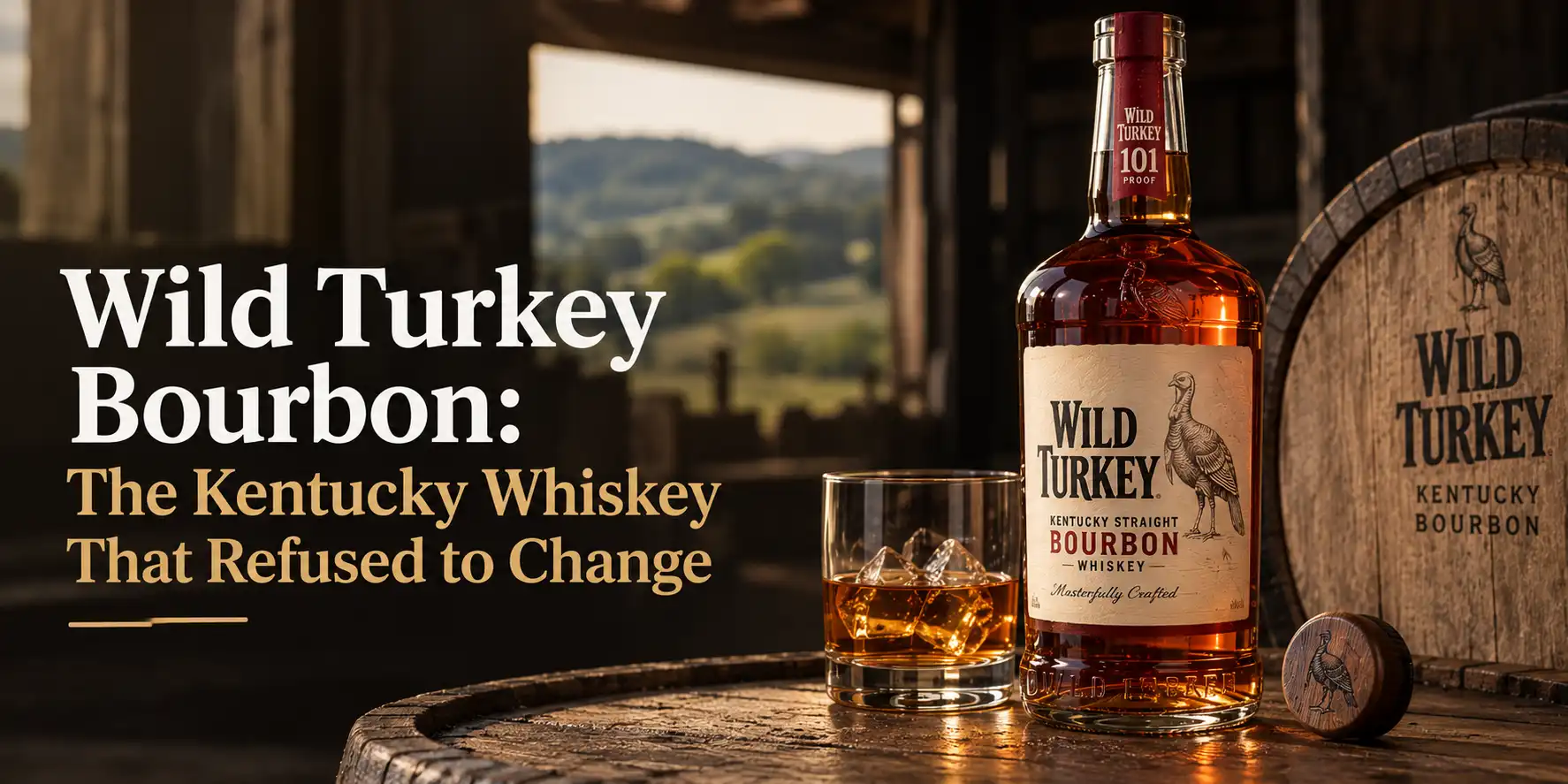
Wild Turkey Bourbon has never been particularly interested in following the crowd.
While American whiskey went through decades of changing tastes, lighter spirits, shifting trends, and evolving production styles, Wild Turkey continued building its identity around something much simpler:
Make the bourbon the same way. Make it with character. And don't water it down.
That philosophy is closely tied to Jimmy Russell, the legendary Master Distiller who joined the distillery in 1954 and eventually became one of the most influential figures in modern bourbon.
Today, the Wild Turkey name stretches from its unmistakable Wild Turkey 101 to barrel-proof expressions such as Rare Breed and limited releases built around generations of Russell family experience.
But the story begins much earlier.
Where Did Wild Turkey Bourbon Come From?
The Wild Turkey story reaches back to the historic distilling tradition of Lawrenceburg, Kentucky.
The distillery's roots trace to the Ripy family, who were producing bourbon on Wild Turkey Hill in the 19th century. The name Wild Turkey came later.
In 1940, a distillery executive brought bourbon along on an annual wild-turkey hunting trip. His friends enjoyed the whiskey so much that they asked for the same bourbon the following year.
The nickname stuck.
And eventually, Wild Turkey became the name on the bottle.
What started as a hunting-trip nickname would eventually become one of Kentucky bourbon's most recognizable names.
The Jimmy Russell Era Changed Everything
If the Wild Turkey name created the identity, Jimmy Russell built the legacy.
Jimmy Russell started working at the distillery in 1954 at just 18 years old. Over the following decades, he learned the traditional Kentucky approach to bourbon and eventually became Master Distiller.
But his importance to Wild Turkey goes beyond longevity.
During the 1970s and 1980s, bourbon faced serious challenges as American drinkers increasingly moved toward lighter spirits.
Many brands adapted.
Jimmy Russell didn't.
He continued making the bourbon in the style he believed was right rather than radically changing the whiskey to chase the market.
That decision became one of the defining stories behind Wild Turkey bourbon history.
The brand wasn't trying to become something new.
It was protecting what it already believed bourbon should be.
Wild Turkey 101: The Bourbon That Became the Signature
For many drinkers, Wild Turkey means one thing:
Wild Turkey 101 is a Kentucky straight bourbon bottled at 101 proof and aged between six and eight years. Its high-rye character, deeply charred American oak barrels, and higher proof give it the bold profile that became synonymous with the brand.
Its profile is built around familiar bourbon sweetness, but the experience doesn't stop there.
Vanilla and caramel appear first.
Oak and baking spice follow.
Then comes the signature Wild Turkey spice, with orange peel carrying through the finish.
That combination is important because Wild Turkey 101 bourbon isn't designed to disappear into the background.
It has enough proof and spice to remain recognizable whether you're drinking it neat, over ice, or using it in a cocktail.
And that's part of what made 101 so enduring.
Why Is Wild Turkey 101 So Recognizable?
The answer isn't simply the number on the label.
It's the combination of proof, rye, oak, and production philosophy.
Wild Turkey uses heavily charred American white oak barrels for 101, and the bourbon's high-rye character adds a layer of spice beneath the vanilla and caramel sweetness.
The result is a bourbon that doesn't need an elaborate description to make an impression.
It tastes like Wild Turkey.
That may sound obvious, but creating a recognizable house style is one of the hardest things a whiskey brand can accomplish.
What Makes Wild Turkey Bourbon Different?
The easiest way to understand Wild Turkey is to look at the decisions the distillery has continued to make.
- Higher proof.
- A pronounced rye influence.
- Heavy barrel char.
- Longer aging than the minimum required for straight bourbon.
- A commitment to a traditional production style.
Those choices create a profile that is immediately recognizable across much of the Wild Turkey lineup.
And the brand's production philosophy emphasizes consistency rather than constantly reinventing the core bourbon.
Wild Turkey Rare Breed Took the Same Philosophy Further
Wild Turkey didn't stop with 101.
In 1991, the brand introduced Wild Turkey Rare Breed, one of the early barrel-proof bourbons to reach the market.
Rare Breed follows the same basic philosophy as 101, but with considerably more intensity.
It is a blend of six-, eight-, and twelve-year-old bourbon bottled at barrel proof without adding water before bottling. The current expression is listed at 112.8 proof.
The flavor moves deeper into the Wild Turkey profile:
- Warm grain and spice
- Vanilla
- Honey
- Dates
- Black pepper
- Almonds
- A long, spicy finish
It's essentially another argument for the same idea:
Wild Turkey doesn't need to soften its personality to make bourbon interesting.
Kentucky Spirit Put Another Face on Wild Turkey
In 1995, Wild Turkey introduced Kentucky Spirit, a single-barrel 101-proof bourbon.
At the time, single-barrel American whiskey was still far less common than it is today.
That release showed another side of the Wild Turkey approach.
101 established the house style.
Rare Breed pushed intensity.
Kentucky Spirit showed what happens when the character of an individual barrel becomes part of the experience.
The underlying identity remained Wild Turkey.
The expression simply gave it another dimension.
Vintage Wild Turkey: Cheesy Gold Foil and Beyond Duplication
Wild Turkey's history also lives on in older bottles tucked away in home bars, inherited collections, and estate cabinets. Two names you may encounter are Beyond Duplication and Cheesy Gold Foil.
Beyond Duplication was an early Wild Turkey 12-year-old, 101-proof release introduced in the 1980s. Its packaging varied across markets, and export bottles continued appearing after the domestic label changed.
“Cheesy Gold Foil,” often shortened to CGF, is the nickname enthusiasts gave another vintage Wild Turkey 12-year-old, 101-proof bottling with a distinctive reflective gold label. The nickname refers to its packaging—not an official product name or an added ingredient.
Both are part of Wild Turkey's vintage history.
Identifying a particular bottle requires more than recognizing the name: label details, bottle size, proof, seal, and fill level can all help distinguish releases and assess condition.
If you have an older Wild Turkey bottle, those details become especially important before trying to determine what release you have or whether it may be suitable for resale.
The Russell Family Legacy
Wild Turkey's story is also a family story.
Jimmy Russell's son, Eddie Russell, joined the distillery in 1981 and eventually became a Master Distiller himself.
That created something unusual in American whiskey: a direct connection between generations of bourbon-making knowledge.
The Russell approach wasn't about turning Wild Turkey into something completely different.
It was about understanding why the whiskey tasted the way it did—and knowing which parts were worth preserving.
That philosophy has continued into modern Wild Turkey releases.
Wild Turkey Generations: When the Russell Story Became the Whiskey
One of the clearest examples is Wild Turkey Generations.
The release represents a collaboration between generations of the Russell family and combines hand-selected bourbon stocks aged from nine to fifteen years.
It is bottled at 120.8 proof and presented as a barrel-proof, non-chill-filtered whiskey.
But its significance goes beyond age or proof.
Generations represents the evolution of the same philosophy that helped define Wild Turkey in the first place:
Learn from the past without losing the identity of the whiskey.
That's what makes the Russell story so important to understanding Wild Turkey.
What Does Wild Turkey Bourbon Taste Like?
There isn't one single answer because the Wild Turkey portfolio covers several styles.
But the core Wild Turkey bourbon taste is built around a recognizable combination of sweetness, oak, spice, and heat.
Wild Turkey 101 brings vanilla and caramel together with oak, baking spice, cinnamon, and orange peel.
Rare Breed adds greater intensity, with deeper spice and barrel character.
And single-barrel or limited expressions can reveal different sides of the same underlying distillery character.
That's the interesting part.
You can move through the Wild Turkey lineup without losing the thread connecting the bottles.
Wild Turkey 101 in an Old Fashioned
Wild Turkey 101 also earned a strong reputation as a cocktail bourbon because its higher proof and bold flavor can remain present alongside sugar, bitters, and citrus.
The expression works particularly well in an Old Fashioned because its character can remain prominent instead of disappearing behind the other ingredients.
That's another reason the expression has remained so recognizable.
It works as a sipping bourbon.
It works in classic cocktails.
And it still tastes unmistakably like Wild Turkey.
Wild Turkey and the Meaning of “Classic”
The word classic gets used too easily in whiskey.
A bottle doesn't become classic simply because it has been around for a long time.
Wild Turkey is different.
Its identity survived changing consumer preferences without completely reinventing itself.
The brand kept the 101 name.
Kept the bold profile.
Kept the Russell influence.
And continued building new expressions around the same underlying character.
That consistency is a major part of the Wild Turkey bourbon heritage.
Wild Turkey Then and Now
The easiest way to understand Wild Turkey is through the people and releases that shaped it.
There was the early Kentucky distilling tradition that established the foundation.
Then came the Wild Turkey name in 1940.
Then Jimmy Russell in 1954.
Then Wild Turkey 101 became the expression most closely associated with the brand.
Rare Breed followed in 1991.
Kentucky Spirit arrived in 1995.
And later generations of the Russell family continued expanding the portfolio without abandoning the identity that made Wild Turkey recognizable in the first place.
Alongside those modern releases, bottles such as Beyond Duplication and Cheesy Gold Foil remain part of Wild Turkey's vintage history.
The bottle may have changed over the decades.
The philosophy largely didn't.
How Much Is My Old Wild Turkey Bottle Worth?
There isn't one fixed answer to the question, “How much is my old Wild Turkey bottle worth?”
The specific release matters more than simply knowing that the bottle is old.
Factors such as the exact expression, production period, proof, bottle size, label condition, seal or tax strip, fill level, packaging, and current collector demand can all influence what a particular bottle may be worth.
That means two bottles that both look like old Wild Turkey 101 can have very different values.
If you have a bottle you're unsure about, don't rely only on its age or the name on the front label.
Midwest Whiskey Buyer allows bottle owners to submit details and photos for a market-based review. The company specifically evaluates vintage whiskeys, including Wild Turkey, and considers factors such as fill level, tax-strip integrity, label condition, release history, and current collector demand.
Where Can I Sell Vintage Wild Turkey?
If you're wondering where you can sell vintage Wild Turkey, start by identifying the specific bottle and documenting its condition.
A specialist whiskey buyer can review the bottle based on its individual release and condition rather than relying on a generic online price.
Midwest Whiskey Buyer's Sell Your Bourbon page specifically lists Wild Turkey among the collectible bourbon brands it buys and allows sellers to submit photos if they're unsure what they have.
When submitting a bottle, include clear photos of the front and back labels, seal or tax strip, fill level, bottle size, and any original packaging. These details can make identification and evaluation more accurate.
Why Wild Turkey Bourbon Still Matters
Wild Turkey is interesting because its legacy isn't built around trying to be everything to everyone.
It has a point of view.
Bold bourbon.
Higher proof.
Pronounced spice.
Heavy oak character.
Traditional production.
And above all, consistency.
That's why Wild Turkey 101 remains more than another bottle on a bourbon shelf.
It's the expression that carries the identity of the entire brand.
Rare Breed shows what happens when that identity is pushed toward barrel proof.
Kentucky Spirit shows the influence of individual barrels.
Vintage releases such as Beyond Duplication and Cheesy Gold Foil show how that identity has been preserved in bottles from earlier eras.
And the Russell family story explains why all of them still feel connected.
The Bottom Line on Wild Turkey Bourbon
Wild Turkey Bourbon is not simply a Kentucky whiskey with a memorable name.
Its history is built around a very specific idea: don't sacrifice character just because the market changes.
The Wild Turkey name began in the 1940s.
Jimmy Russell joined the distillery in 1954 and became the person most closely associated with its traditional style.
Wild Turkey 101 turned that style into an American whiskey icon.
Rare Breed pushed the same philosophy into barrel-proof bourbon.
Kentucky Spirit explored the character of individual barrels.
Vintage releases such as Beyond Duplication and Cheesy Gold Foil became part of the brand's collector history.
And the Russell family continued the tradition across generations.
That is ultimately what makes Wild Turkey Bourbon worth remembering.
Not just the 101 proof.
Not just the bottle.
Not just the history.
But the fact that, through decades of change, Wild Turkey managed to remain unmistakably Wild Turkey.
Some bourbons evolved with the times.
Wild Turkey made the times catch up with it.
Tapped: sell whiskey online' /sell-your-bourbon/ /sell-rare-whiskey-online-in-the-usa/
.Also Read: top-10-valuable-whiskey-bottles-you-might-own' /how-much-is-my-whiskey-worth/ /antique-whiskey-bottles-price-guide/ /how-much-is-my-old-bourbon-worth/ /bourbon-oversupply / /where-to-sell-my-whiskey-in-2026 /most-valuable-whiskey-bottles-to-sell / /selling-whiskey-vs-auctioning-it-pros-and-cons/ /stitzel-weller-old-fitzgerald-bottle-identification-guide / very-old-fitzgerald-vs-old-fitzgerald-bottled-in-bond /


